Types of Call Centers: Key Differences and How to Choose the Right One
Not every business communicates with customers in the same way. Some companies need a team to answer questions and resolve service issues, while others rely on outbound calls to follow up with prospects, support sales, or contact existing customers. Businesses with distributed teams may also need a flexible way to manage calls across different locations. That is why choosing a call center is not simply a matter of selecting a phone system. The right setup depends on call direction, business objectives, team structure, and the technology used to manage daily operations. In this guide, VoIP Egypt explains the main types of call centers, how they differ, and what businesses should consider when choosing a suitable solution.
What Is a Call Center?
A call center is a system businesses use to manage telephone communication with customers. It may handle inbound calls, outbound calls, or both, with tools for routing calls, recording interactions, and monitoring performance.
Call centers can support several business functions, including customer service, technical support, sales, order follow-ups, and customer satisfaction surveys.
Their setup varies according to the direction of calls, the way the team operates, and the technology behind the system. Understanding these differences helps businesses choose a model that fits their actual needs.
What Are the Main Types of Call Centers?
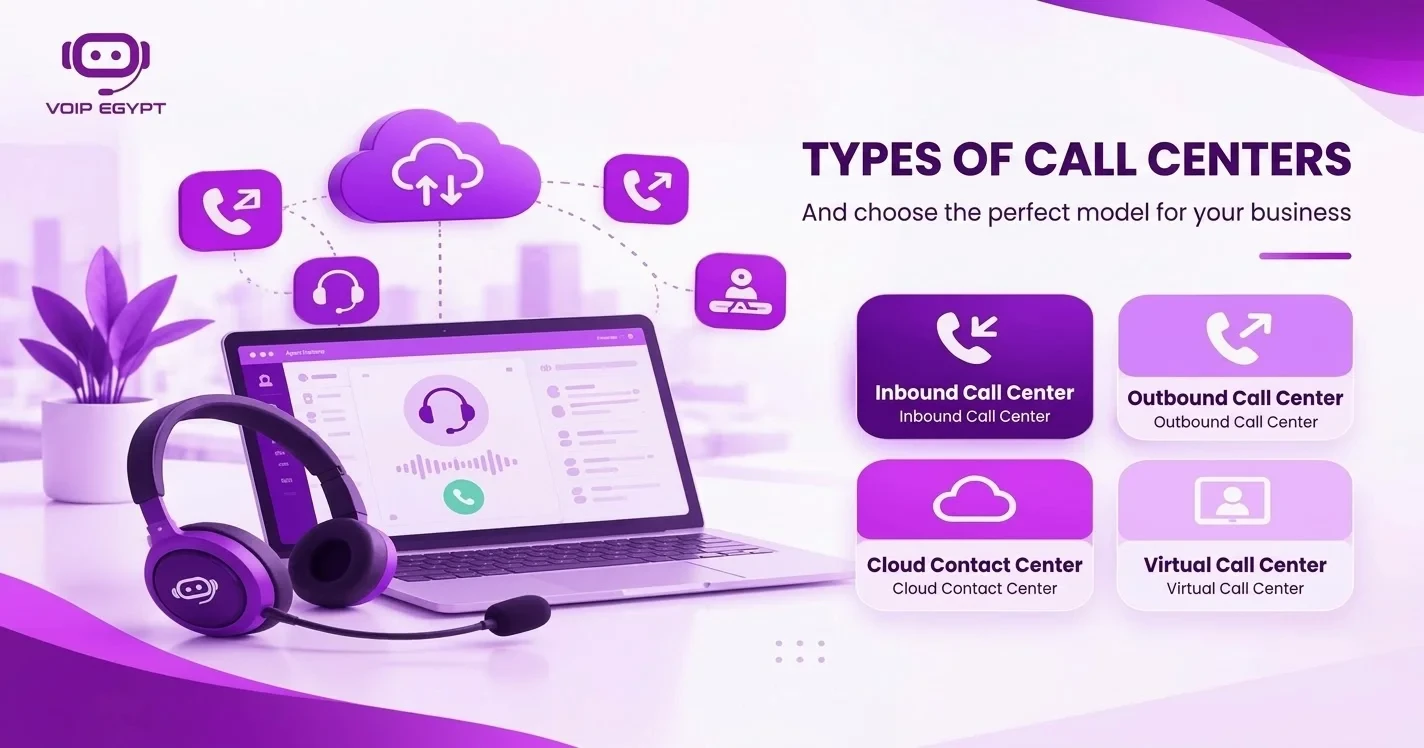
Call centers can be classified by call direction or by how the system and team are operated. The main models include the following.
1. Inbound Call Center
An inbound call center handles calls initiated by customers who contact a business for information, assistance, or support.
Common uses include:
-
Answering questions about products and services.
-
Handling customer complaints and service requests.
-
Providing technical support.
-
Routing calls to the appropriate department.
-
Following up on orders or ongoing service issues.
This model is suitable for businesses that need to respond to customer requests, including service providers, telecommunications companies, and e-commerce businesses.
Its effectiveness depends on having clear call-routing procedures, trained agents, and a process for tracking requests that cannot be resolved immediately.
2. Outbound Call Center
An outbound call center focuses on calls made by a business to existing customers or potential customers, rather than relying only on incoming calls.
Common uses include:
-
Contacting sales prospects.
-
Following up on leads and sales opportunities.
-
Conducting customer surveys.
-
Sending appointment or payment reminders where appropriate.
-
Following up after a purchase or service interaction.
Outbound call centers are useful for businesses that need to initiate customer communication. Sales teams may use them to follow up on opportunities, while other departments may use outbound calls for research or customer retention.
Businesses should organize outbound campaigns in line with applicable telemarketing, privacy, and consent requirements.
3. Cloud Contact Center
A cloud contact center uses a cloud-hosted platform to manage communication operations instead of relying entirely on infrastructure installed at the company's premises.
Depending on the provider and plan, features may include:
-
Centralized call management.
-
Flexible capacity as business needs change.
-
Call routing and queuing.
-
Call recording and reporting.
-
Remote access for distributed teams.
-
Integration with CRM and other business applications.
Cloud-based systems can be useful for businesses that want operational flexibility and room to grow without managing every component of their communications infrastructure locally.
However, the right solution depends on subscription costs, internet reliability, security requirements, integration needs, and the features included in the chosen platform.
4. Virtual Call Center
A virtual call center allows agents to work from different locations while remaining connected to a shared communication and management system. Employees do not all need to work from the same physical office.
Common advantages include:
-
Supporting remote and hybrid teams.
-
Hiring agents across different locations.
-
Managing calls through a centralized system.
-
Reducing dependence on a single office location.
This model can suit businesses with distributed teams or remote customer service operations.
To work effectively, virtual call centers need reliable internet access, suitable devices, secure access controls, and clear procedures for monitoring performance and protecting customer information.
A virtual call center is not necessarily separate from a cloud contact center. A business can use a cloud platform to support agents working remotely.
What Is the Difference Between Call Center Types?
Each model serves a different purpose, although some can be used together.
|
Type |
Primary purpose |
Suitable for |
|---|---|---|
|
Inbound |
Receiving customer calls |
Customer service and support |
|
Outbound |
Making calls to customers |
Sales and follow-ups |
|
Cloud |
Managing communications through a cloud-hosted platform |
Businesses seeking flexibility and scalability |
|
Virtual |
Supporting teams across multiple locations |
Remote and distributed workforces |
Important: These categories are not mutually exclusive. A business can handle both inbound and outbound calls through a cloud platform while employing agents who work remotely.
How Do You Choose the Right Call Center for Your Business?
The right setup depends on your communication goals, call volumes, staffing requirements, and technical needs. Consider the following factors before making a decision.
1. Define Your Main Objective
If your priority is responding to customer questions and complaints, an inbound model may be appropriate. If your team needs to contact prospects, follow up on leads, or support sales activities, an outbound model may be more suitable.
2. Assess Call Volume and Patterns
Review inbound and outbound call volumes, peak periods, average handling time, and staffing needs. These details help determine the capacity and features required.
3. Choose the Right Operating Model
Businesses with remote employees or teams across several branches may benefit from cloud-based or virtual operations. The decision between cloud-hosted and on-premises infrastructure should also account for security, integration, support, and budget requirements.
4. Identify Essential Features
Consider whether your team needs automatic call routing, call queues, recording, reporting, CRM integration, or connections with technical support tools.
Prioritize features that solve real operational problems instead of paying for tools your team may not use.
5. Plan for Future Growth
Choose a system that can adapt as call volumes increase or new employees join. Consider the total cost of ownership, call quality, technical support, and the ability to add users or features.
Some businesses will benefit from combining several models. The goal is to build a communication setup that supports the company's workflow rather than forcing the business to adapt to an unsuitable system.
Find the Right Call Center Solutions With VoIP Egypt
If your business needs a more organized way to handle customer calls, start by identifying your communication goals, team structure, and essential system features.
VoIP Egypt provides business communication and call center solutions designed to help companies manage calls, organize teams, and monitor performance according to their operational needs.
Contact VoIP Egypt to explore available call center solutions and discuss which options may suit your business and future plans.